Whistling Straits
N8501 County Road LS, Sheboygan, WI 53083Part of Destination Kohler →Designed by Pete Dye · Est. 1998
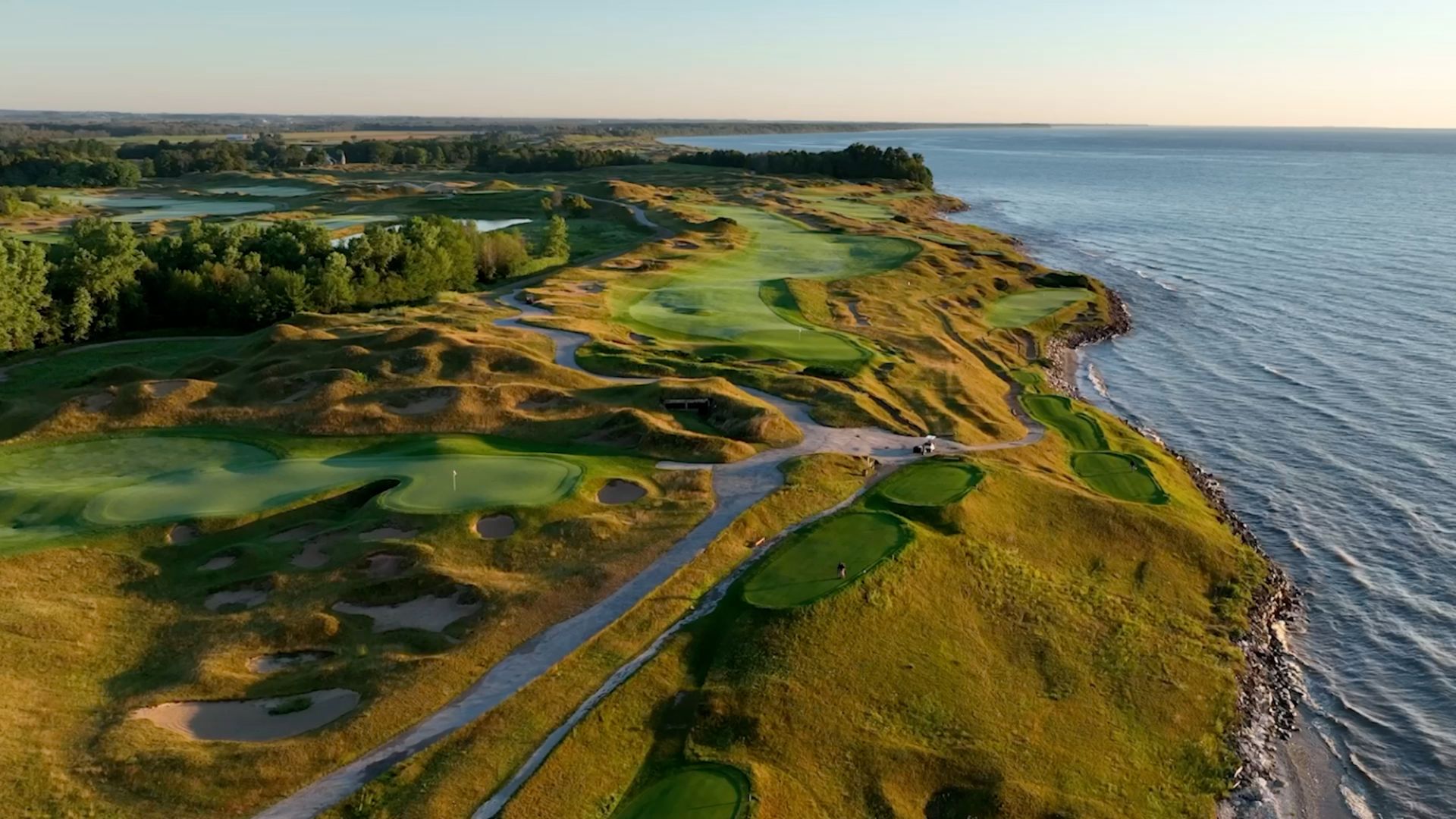
Pete Dye transformed a flat, former military training ground on the shore of Lake Michigan into a links-style layout featuring over 1,000 bunkers -- many of them hidden in fescue-covered dunes -- along two miles of windswept shoreline. The manufactured terrain mimics the rumpled, tumbling linksland of County Kerry and County Clare, with sod-walled bunkers, exposed sandy blowouts, and greens perched on natural-looking plateaus above the lake. Wind off Lake Michigan changes the course's character dramatically from day to day.
History
The land on which Whistling Straits was built has a history that predates golf by generations. The two-mile strip of Lake Michigan shoreline in Haven, Wisconsin, north of Sheboygan was the site of Camp Haven, a World War II military installation. Wisconsin Electric later acquired the property intending to build a nuclear power plant, a project that was never completed. The land passed through corporate ownership until Herb Kohler — Executive Chairman of the Kohler Company and the developer behind the American Club resort — purchased it from the power company in May 1995 after eighteen months of negotiations. Kohler had already worked with Pete Dye on the River Course and the two Blackwolf Run layouts in nearby Kohler, Wisconsin, and he returned to Dye with a commission for a full links-style course that would evoke the windswept coastlines of Ireland and Scotland on a Lake Michigan shore. Pete Dye designed the Straits Course in collaboration with Alice Dye, his longtime design partner, and it opened in 1998 after among the labor-intensive construction projects in American golf history. The site was essentially flat — former military base terrain with scrubby vegetation and no natural topographic drama. To create the rolling links landscape that Kohler envisioned, more than 7,000 truckloads of sand totaling approximately 105,000 cubic yards were imported and shaped into the dunes, ridges, hollows, and swales that now define the course's character.
Nearly 1,000 bunkers were cut into the sand structures to create the visual and strategic vocabulary of a coastal links. The black-faced sheep that graze freely on the course were introduced as a deliberate aesthetic element evoking the Irish and Scottish coast and have become one of the course's defining visual signatures. The Straits Course stretches to 7,790 yards from its championship tees, with every hole either adjacent to Lake Michigan or within sight of it. Wind off the lake — which can arrive from any compass point — is the course's primary defense. In calm conditions the layout yields scoring opportunities; in a full northwest blow off the lake it becomes among the demanding tests in American golf. The par-5 eighteenth plays along the lake with a green set almost at the water's edge, providing a dramatic closing hole. Dye's bunkers are deep, irregularly shaped, and distributed so densely that the course has almost no conventional rough — in practice, finding sand is the most common consequence of errant shots. The fairway surfaces are firm and fast, rewarding the bump-and-run approach game associated with traditional links play.
The Straits Course has hosted three PGA Championships and the 2021 Ryder Cup. The 2004 PGA Championship was won by Vijay Singh in a three-man playoff after Chris DiMarco was eliminated; Singh defeated DiMarco on the third extra hole. That event produced a notable rules controversy when Dustin Johnson received a two-stroke penalty on the seventy-second hole for grounding his club in a sandy area that officials had designated as a bunker — one of hundreds of similar areas throughout the course, all of which had been marked in advance. The 2010 PGA Championship saw Martin Kaymer win in a sudden-death playoff over Bubba Watson. The 2015 PGA Championship was won by Jason Day, who set a then-scoring record for the major with a 268 total. The 2021 Ryder Cup ended in a decisive American victory, 19-9, the largest winning margin in the modern format, as the United States team dominated with historically consistent performance across all three days of competition. The Straits Course and the adjacent Irish Course — opened in 2000, also designed by Pete Dye — constitute the Whistling Straits facility, both managed as part of Kohler's resort portfolio under the American Club umbrella. The resort undertakes ongoing agronomic work to maintain the sand-based surfaces in the challenging upper-Midwest climate, with particular attention to the native fescue areas and firm fairway turf that produce the running game Dye intended.
Bunker restoration is a regular maintenance priority given the sheer number of sand features and the volume of play the facility receives annually. Whistling Straits ranks among the top thirty courses in Golf Digest's America's 100 Greatest Public Courses. Its setting on the Lake Michigan shoreline, the visual scale of Dye's earthworks, and four major championships in twenty-three years have established it as among the significant American courses built in the final decade of the twentieth century. Herb Kohler's willingness to invest at a scale that most private resort developers would not contemplate produced a course that belongs on the short list of great American links, a category that for most of golf history contained almost only Scottish and Irish names. The resort also includes the nearby Kohler facilities at Blackwolf Run — two courses on the Sheboygan River that together complete a four-course destination comparable in scope and quality to Bandon Dunes or Pinehurst. Herb Kohler's sustained investment over more than three decades transformed a stretch of Wisconsin shoreline and riverbank into among the complete golf destinations in the American Midwest.