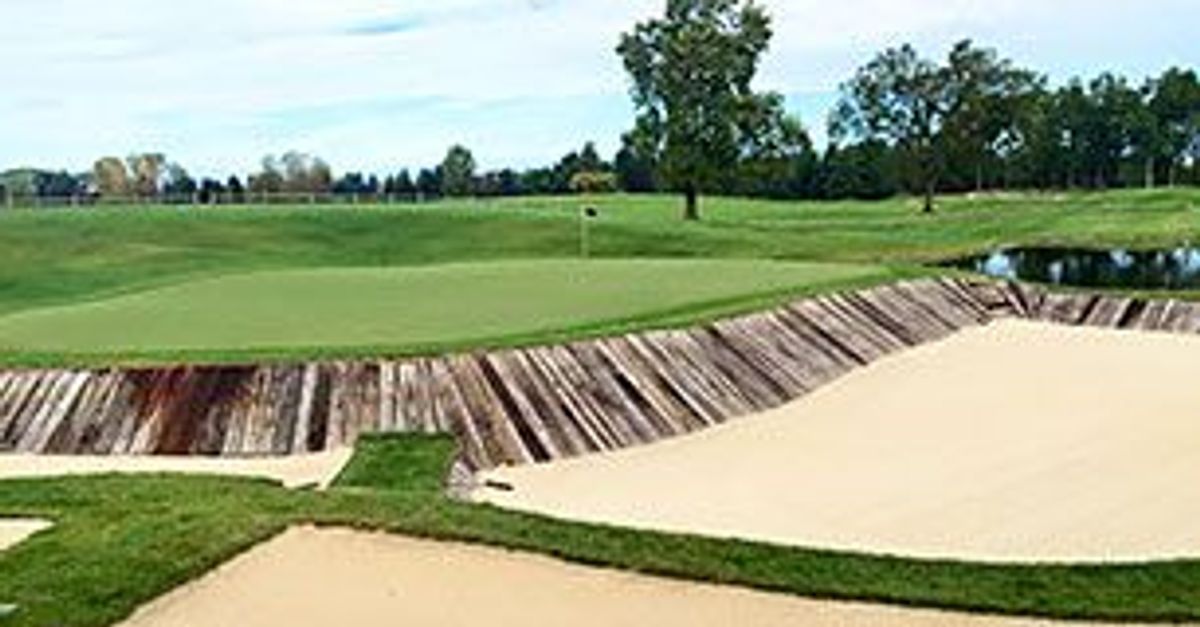
Before Pete Dye became Pete Dye, there was this 1967 provocation in the Ohio countryside — shaggy bunkers, railroad ties, exposed earth, and a deliberate rejection of every manicured convention in American golf. The Golf Club rewrote the rules of what a course could look like, channeling links rawness into a landlocked setting that launched a design revolution. Small membership, zero pretense, all substance.
History
The Golf Club in New Albany, Ohio, occupies a singular place in American golf architecture as the course where Pete Dye first fully realized the design philosophy that would define his legendary career. The club was founded in 1967 by Fred Jones, a Columbus businessman with a deep love of golf and a practical motivation: unable to secure an invitation to join Scioto Country Club, Jones resolved to build his own course. He acquired rolling farmland in what was then the rural community of New Albany, east of Columbus, and hired the relatively unknown Pete Dye to design a course that would stand apart from the manicured parkland layouts prevalent in the Midwest at the time. Dye was in a period of profound creative transformation. In 1963, he and his wife Alice had traveled to Scotland, where they studied the great links courses of the British Isles. The trip changed Dye's understanding of what a golf course could be. He returned to America determined to build courses that worked with the natural contours of the land rather than imposing artificial shapes upon it. The Golf Club became the first full expression of this new vision. Dye later wrote in his autobiography, "Bury Me in a Pot Bunker," that images of Scottish courses, along with the design features at Pinehurst No. 2, Seminole, and Camargo, influenced the characteristics he brought to the New Albany property. The course was laid out on rolling Ohio farmland, and Dye let the terrain dictate the routing rather than forcing the land into a predetermined plan.
This approach, which would later be termed minimalism in golf architecture, was radical for its time. The movement spawned by The Golf Club held that the architect's primary goal should be to discover the holes already latent in the landscape rather than manufacture them through heavy earthmoving. The result is a course that sits naturally and understated within its property, appearing as though the holes have always been there. The routing unfolds in three distinct sections, each with its own character. The first six holes traverse conventional parkland, with generous fairways and gently rolling terrain establishing a welcoming rhythm. The middle six holes tighten considerably, threading through dense corridors of mature trees where accuracy off the tee becomes paramount. The final six holes open into links-inspired terrain, with broader vistas, native grasses, and an unmistakable echo of the Scottish courses that had so deeply influenced Dye's thinking. This three-part structure gives the round a narrative arc that few courses can match, each section presenting a fundamentally different challenge and aesthetic experience. Blacklick Creek meanders through the property and comes into play on four holes, introducing a natural water hazard that predates the artificial ponds and lakes that became common in later decades of course construction. Dye incorporated a variety of grasses that give the course a heathland character, with acres of fescue lining fairways and creating a visual and strategic framework that was unusual for Midwestern golf in the 1960s.
The course also features what are recognized as among the first notable uses of Dye's signature railroad ties and pot bunkers in American golf. These elements, which would become hallmarks of Dye's later work at courses like Harbour Town, Crooked Stick, and TPC Sawgrass, appear at The Golf Club in their earliest and arguably most organic form, integrated into the landscape rather than applied as decoration. The course plays to a par of 72 from a total length of 7,268 yards, with a course rating of 75.3 and a slope rating of 140 on bentgrass greens. The greens themselves are subtle and challenging, with contours that reflect the surrounding terrain and demand a strong putting game. During the design process, Dye enlisted the help of a twenty-seven-year-old local named Jack Nicklaus, already an established force on the PGA Tour, to help verify shot selections and test strategic concepts. Nicklaus visited the construction site repeatedly, offering suggestions that Dye found astute and valuable. The collaboration sparked a five-year design partnership between Dye and Nicklaus that produced Harbour Town Golf Links on Hilton Head Island, among other courses. Nicklaus himself has credited his time at The Golf Club as the experience that first taught him about course design, describing his role there as that of an unpaid consultant who learned as much as he contributed. The club's founder, Fred Jones, maintained a personal connection to Nicklaus that predated the course: Jones had famously given the young Nicklaus his first job as an insurance salesman. This web of relationships between Jones, Dye, and Nicklaus gives The Golf Club a unique place in the social history of American golf, as the intersection point where three significant figures in the game came together at a formative moment in each of their careers.
The signature third hole is a par 3 playing approximately 220 yards, with a pond fronting the green and a large bunker encompassing the left and rear portions of the putting surface. The bunker faces are constructed with railroad ties, creating the bold visual and strategic definition that Dye would refine throughout his career. The hole encapsulates the course's broader design ethic: natural beauty combined with uncompromising strategic demand. The Golf Club has maintained its original character remarkably well over more than five decades. Unlike many courses of its era, it has not been subjected to extensive redesign or modernization. The routing and design features remain essentially as Dye conceived them, making the course a living document of a standout important turning points in golf architecture history. Ranking panels have consistently recognized its significance: Golf Digest and Golf Magazine have placed The Golf Club among the top courses in the United States for decades. It stands as the benchmark by which all other courses in Ohio are measured, and its influence on Dye's subsequent body of work, and on the minimalist movement it helped inspire, extends far beyond the boundaries of its New Albany property.