Streamsong Red
1000 Streamsong Drive, Bowling Green, FL 33834Part of Streamsong Resort →Designed by Bill Coore & Ben Crenshaw · Est. 2012
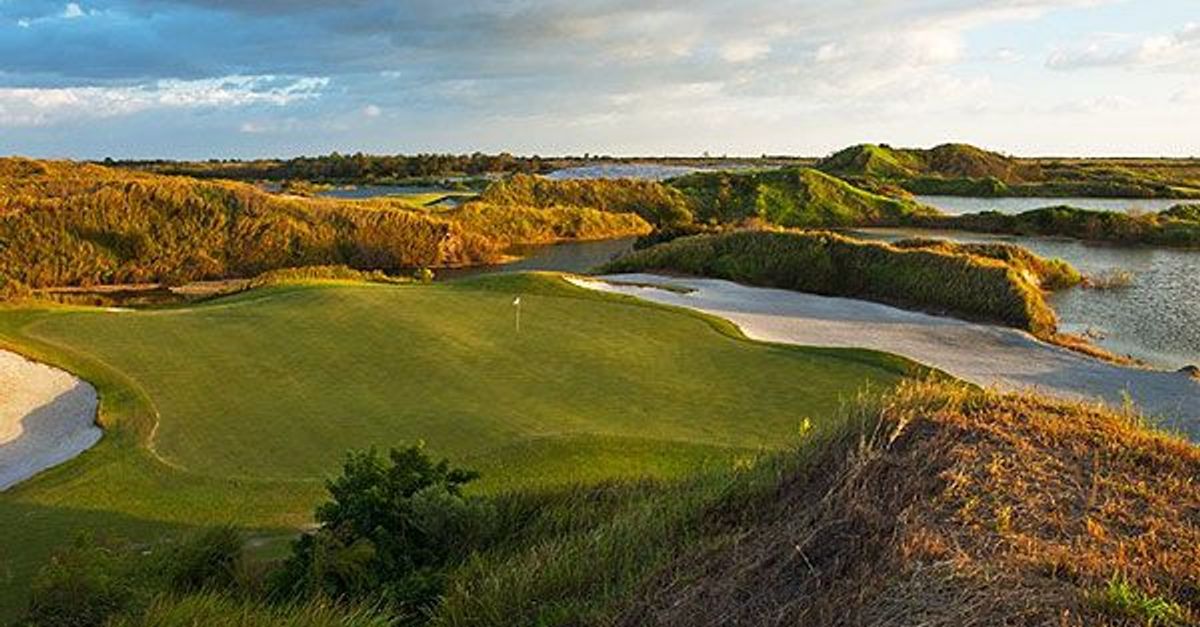


Streamsong Red winds through towering sand ridges and open savannah created by a century of phosphate mining, where Coore and Crenshaw discovered terrain unlike anything else in Florida. The course plays across dramatic elevation changes -- some dunes reach 75 feet -- with natural bunkers carved into the sandy slopes and greens that reward creative shotmaking. The routing alternates between intimate corridors framed by tall grasses and expansive views over the surrounding wetlands and lakes.
History
Streamsong Red opened in late 2012 as the first of what would eventually become three championship courses at Streamsong Resort — a golf destination built on 16,000 acres of former phosphate strip-mining land in Polk County, Florida, developed by the Mosaic Company as a prototype for post-mining economic and environmental reclamation. The landscape that Mosaic offered to Bill Coore and Ben Crenshaw was unlike anything either architect had encountered in Florida. A century of phosphate extraction had left the land shaped by massive earthmovers and wind erosion, producing rolling terrain of sand dunes, ridges, and depressions entirely foreign to the flat, water-table-constrained landscape that characterizes most of the state. The region, known locally as Bone Valley for the density of ancient mammal fossils embedded in its phosphate deposits, presented the designers with a canvas that resembled links ground more than subtropical farmland. Coore and Crenshaw recognized immediately that the site demanded a design philosophy aligned with their core convictions: follow the land, move minimal earth, build wide corridors, and trust the natural contours to create strategic variety. Coore and Crenshaw designed the Red Course to play through the most dramatic of the site's manufactured dunes — ridges and hollows that rise and fall with an amplitude unprecedented in Florida golf. The routing uses these landforms to create hole sequences that alternate between expansive views from elevated tees and intimate corridors through cut valleys.
The course plays to a par of 72 and stretches approximately 7,100 yards from its back tees, with a character defined by wide fairways, enormous naturalistic bunker complexes, and greens that demand ground-level understanding as much as aerial precision. Coore and Crenshaw deployed their trademark approach of building greens that accept run-up shots from multiple angles, giving the Red Course a bounce-and-run texture unusual for modern American course design. The strategic framework of the Red Course draws on the firm's experience at Sand Hills and Bandon Trails — designs where the land's natural movement provided the primary architectural drama without engineered complexity. At Streamsong, the former mining dunes provided even more exaggerated topography than either of those properties, and Coore and Crenshaw used that amplitude to create approaches where the ground contours visible below the green actively direct or redirect the ball in ways that reward careful reading. Several holes use false fronts and swales around the greens to create scoring variance that reflects genuine strategic choices made from the fairway rather than simply distance calibration. Golf Digest and Golfweek both named Streamsong Red among the best new courses of 2012, and Golfweek listed it among the top 40 public courses in the world in 2013. Since then it has appeared consistently in national rankings of public-access courses, often cited alongside the Blue and Black courses as part of among the concentrated collections of accomplished public golf in the United States.
With Tom Doak's Blue Course — which opened simultaneously in 2012 — and Gil Hanse's Black Course, which followed in 2017, Streamsong became the first resort to feature original designs from all three architects who define the contemporary American minimalist movement. The Red Course has been praised by architecture critics for demonstrating that genuinely interesting golf can be built in Florida — a state whose flat, sandy topography and high water tables have historically constrained course design to formulaic layouts with artificial lakes and engineered mounding. Streamsong Red demonstrated that with the right raw material and designers willing to follow rather than fight the land, Florida could produce courses of national significance. Golf Digest and Golfweek both named Streamsong Red among the best new courses of 2012, and Golfweek listed it among the top 40 public courses in the world in 2013. Since then it has appeared consistently in national rankings of public-access courses, often cited alongside the Blue and Black courses as part of among the concentrated collections of accomplished public golf in the United States. The Red Course has been praised by architecture critics for demonstrating that genuinely interesting golf can be built in Florida — a state whose flat, sandy topography and high water tables have historically constrained course design to formulaic layouts with artificial lakes and engineered mounding. Streamsong Red demonstrated that with the right raw material and designers willing to follow rather than fight the land, Florida could produce courses of national significance.
The course plays to a par of 72 and stretches approximately 7,100 yards from its back tees, with firm playing surfaces that produce bounce-and-run conditions unlike virtually anything else in Florida golf. Ben Crenshaw and Bill Coore's approach to the Red Course embraced the former phosphate mining landscape's most extreme features rather than softening them. The ridgelines and valleys left by the mining operations provided natural routing corridors and green sites that no amount of design could have manufactured on flat Florida terrain. The result is a course with genuine topographic variety — a quality so rare in Florida golf that it alone would justify the Red Course's position in national rankings, even before accounting for the quality of Coore and Crenshaw's strategic thinking.