Sleepy Hollow Country Club
777 Albany Post Rd, Scarborough, NY 10510Designed by Charles Blair Macdonald · Seth Raynor · Est. 1911
Redesigned by A.W. Tillinghast (1930)
Redesigned by Rees Jones (1992)
Redesigned by Gil Hanse (2006)
Redesigned by George Bahto (2006)
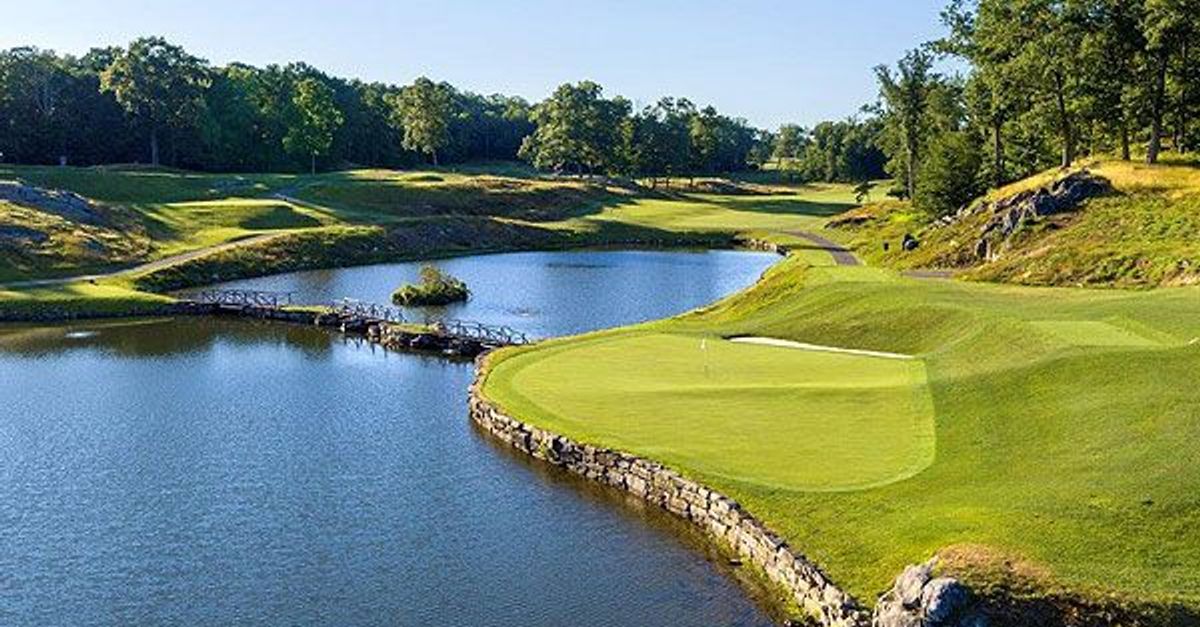
Sleepy Hollow Country Club is a historic private club set on 338 acres along the Hudson River in Scarborough, New York. Its Upper Course, designed by Charles Blair Macdonald and Seth Raynor and later refined by A.W. Tillinghast and Gil Hanse, is a standout layouts in the metropolitan New York area.
History
Sleepy Hollow Country Club occupies a remarkable piece of ground in the Hudson River Valley of Westchester County, New York, where the river widens to nearly three miles near what is now the Tappan Zee crossing. The club was incorporated on May 11, 1911, with six hundred members drawn from the upper echelons of American society. The founding board of directors reads like a register of Gilded Age wealth: John Jacob Astor IV, who would perish aboard the Titanic the following year; coal baron Edward Julius Berwind; sportsman W. Averell Harriman; Cornelius Vanderbilt III; Frank Vanderlip, president of National City Bank and a key figure in the creation of the Federal Reserve System; and William Rockefeller of Standard Oil. Percy Rockefeller also counted among the founding group. These men sought to create a country club that matched the grandeur of the Hudson River setting, and to design the golf course, they turned to Charles Blair Macdonald, the most important American golf architect of the early twentieth century. Macdonald had spent years studying the great links courses of the British Isles, traveling to Scotland, England, and Ireland to survey and measure what he considered the finest holes in golf. From these studies, he distilled a collection of template holes, classic strategic concepts drawn from holes like the Redan at North Berwick, the Road Hole at St Andrews, the Punchbowl at various links, and the Eden at St Andrews. These templates became the foundation of Macdonald's design philosophy, and he employed them with greater frequency and conviction than any of his contemporaries. At Sleepy Hollow, he enlisted Seth Raynor, an engineer by training who would become his most accomplished protege, to help execute the vision. It was the third collaboration between the two men, and Raynor was still developing his skills as a golf course builder.
Construction proved slow and difficult due to the rocky terrain. The course opened in 1914, spread across 340 acres of dramatically contoured land overlooking the Hudson River. Macdonald incorporated several of his signature template holes into the routing, including a reverse Redan, a Punchbowl green, and an Eden-style par three. The site's natural topography, with its steep elevation changes and river vistas, gave Macdonald a canvas unlike any he had worked with before. However, the original collaboration between Macdonald and the membership was not without tension. According to golf historian George Bahto, Macdonald clashed with William Rockefeller over tree removal, a dispute that may have limited the architect's ability to fully realize his vision. Bahto has characterized the initial results as "moderate at best," though this assessment may reflect the compromises Macdonald was forced to accept rather than any deficiency in design ambition. In the late 1920s, the club hired A.W. Tillinghast to expand the layout to twenty-seven holes. Tillinghast created holes 1, 8 through 12, and 18, adding new terrain to the course's portfolio. While Tillinghast was among the greatest architects of his generation, his work at Sleepy Hollow has been viewed as something of an anomaly in his otherwise distinguished career.
The holes he added featured standard back-to-front sloping greens without the fairway bunkering that characterized his best work at places like Baltusrol and Winged Foot. Golf historians have suggested these additions were "uninspiring and repetitive" compared to the Macdonald originals. Over the decades that followed, the course underwent the familiar evolution that befell many Golden Age layouts: trees were planted, bunkers softened, and the original architectural intent gradually obscured. The modern story of Sleepy Hollow begins in 2006, when the club engaged Gil Hanse, a respected restoration architect working today, along with golf historian George Bahto, to renovate the course. The first phase, completed between 2006 and 2007, was transformative. Hanse and Bahto made the deliberate decision to emphasize Macdonald's design principles rather than restore Tillinghast's additions. Strategic tree removal opened interior vistas and revealed the Hudson River panoramas that Macdonald had intended golfers to experience. The course became significantly more open, the interplay between holes more visible, and the strategic demands more legible. A second phase of renovation followed in 2016 and 2017, during which all eighteen greens were redesigned to reflect Macdonald and Raynor aesthetics. Total putting surface acreage increased from 135,460 square feet to 145,200 square feet, a seven percent growth, with dramatic expansions to six greens in particular: the 1st, 8th, 9th, 10th, 14th, and 18th. The first hole was reconceived as a broad Leven-style green with multiple pin positions, replacing the simpler Tillinghast configuration.
The eighth was converted into a Road Hole green complex, adding layers of strategic complexity. The fourteenth was restored with distinctive ridge features using historical photographs as reference, and the fifteenth, the course's signature Punchbowl hole, was converted back to a par four from a par five, reinstating the dramatic green that gives the hole its character. The sixteenth, a short par three, was restored with a classic horseshoe contour and a generous 10,500-square-foot putting surface. The renovation's success owed much to the continuity of club leadership. Michael Hegarty served as president and George Sanossian as Green Committee chairman through extended tenures, ensuring a consistent architectural vision and a strong working relationship with Hanse and Bahto. The club's ambition to showcase the results of this work led to a 2016 inquiry about hosting a USGA championship. The culmination came in 2023, when Sleepy Hollow hosted the 42nd U.S. Mid-Amateur Championship, bringing national competition to the club for the first time and demonstrating that the Hanse-Bahto renovation had produced a course worthy of championship scrutiny. Today, Sleepy Hollow Country Club stands as a testament to what thoughtful restoration can achieve. The Macdonald and Raynor template holes play as their creators intended, the Hudson River vistas frame the round from start to finish, and the dramatic topography creates a playing experience unlike anything else in the New York metropolitan area. The ghosts of the Gilded Age founders still linger in the atmosphere of the place, but the golf course itself looks forward, its architecture restored and refined for a new century of play in the shadow of the Hudson's widest reach.