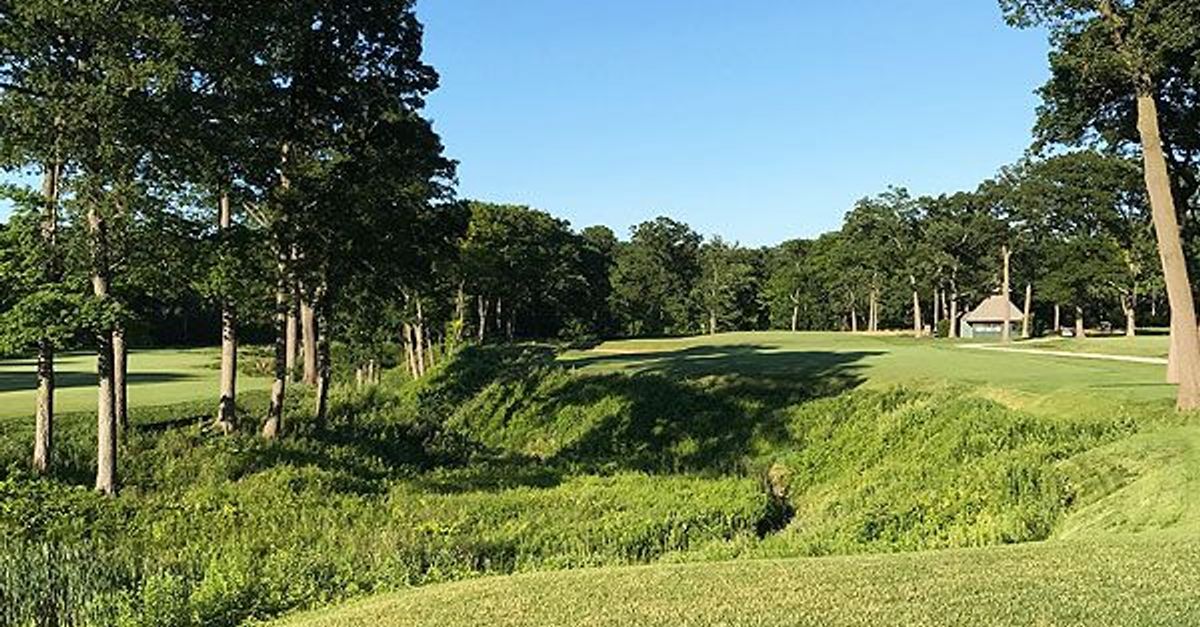
Shoreacres is widely regarded as one of Seth Raynor's finest solo designs, an intimate and strategic masterpiece set along a dramatic ravine on Chicago's North Shore in Lake Bluff, Illinois.
History
The story of Shoreacres begins not with a golf course, but with a group of like-minded Chicagoans who longed for something different from the clubs already dotting the North Shore. In 1916, Stanley Field -- nephew of the great merchandising pioneer Marshall Field -- along with several fellow members of the Onwentsia Club in Lake Forest, incorporated what they initially called "Lakewoods." Within weeks, the name was changed to Shoreacres to avoid confusion with another similarly named club in the area. The formal incorporation date was November 18, 1916, and from the outset, the founding members envisioned a club where men and women could enjoy golf in a relaxed, social atmosphere, set against a standout dramatic pieces of land along the Lake Michigan shoreline. The founders chose a remarkable property in Lake Bluff, Illinois, approximately thirty-five miles north of downtown Chicago. The land was characterized by a series of deep, winding ravines that fed toward Lake Michigan, with flat plateaus sitting between dramatic gullies and creek beds. It was terrain that would challenge most architects, but the founding members had the foresight to hire one of the few designers capable of turning such rugged ground into a masterwork: Seth J. Raynor. Raynor was a Princeton-educated civil engineer and surveyor who had served as Charles Blair Macdonald's right hand during the construction of the National Golf Links of America on Long Island. Under Macdonald's tutelage, Raynor absorbed the philosophy that the greatest holes in golf had already been designed -- at St. Andrews, North Berwick, Prestwick, and other ancient links -- and that the architect's task was to adapt those proven strategic concepts to new terrain. These so-called "template holes" became the hallmark of Raynor's career, and at Shoreacres he deployed them with uncommon brilliance.
Construction was delayed by America's entry into World War I, but by 1921 (some sources cite 1922), Raynor had completed his design and the course opened for play. What he produced is widely regarded as his finest routing and most inventive use of natural terrain. The par-71 layout stretches to roughly 6,318 yards, modest by modern standards, yet its strategic demands and the dramatic ground over which it flows make distance irrelevant to the conversation about its quality. The template holes at Shoreacres are among the purest expressions of the form anywhere in the country. The 3rd hole is Raynor's interpretation of the Leven, while the 6th is his Biarritz -- a par three featuring a massive green some sixty yards long, bisected by a swale approximately six feet deep. The 7th is the Double Plateau, the 8th is the Eden, the 10th is a superb interpretation of the Road Hole, and the 14th is the Redan. Of these, the Eden at the 8th is particularly striking: it plays over a pond to a green defended by deep bunkers on the left, right, and rear, with the putting surface falling steeply from back to front. The Redan at 14 is notable because, unlike many of Raynor's versions that exploit existing terrain, it is entirely manufactured -- Raynor built up the right side of the green to create the characteristic kick from right to left that defines the template. Yet the template holes, as accomplished as they are, do not fully account for Shoreacres' greatness. What sets this course apart from nearly every other Raynor design is its ravine holes. Thirteen of the eighteen holes interact with the property's ravines in some fashion, and the stretch from the 11th through the 13th is among the most celebrated sequences in American golf.
The 11th is a 346-yard par four where a deep ravine cuts in front of the tee, runs along the right side of the fairway, and then sweeps back in front of the green. The golfer must decide how aggressively to challenge the ravine off the tee and again on the approach. The 12th, Raynor's Short template, is a par three that plays down into the ravine itself, creating a photographed hole on the course. The 13th then demands a blind tee shot from a tee box benched into the side of the ravine, the only blind shot in the entire round. This three-hole sequence -- across a ravine, down into it, and back out of it -- is as unique and thrilling as any stretch on a course ranked among America's hundred greatest. The clubhouse deserves mention in any accounting of Shoreacres' history. Famed Chicago architect David Adler designed the original structure in the Tidewater Colonial style, completing it in 1923. It stood as a fitting companion to the course for sixty years until fire destroyed it in late March 1983. In rebuilding, the club commissioned architect Laurence Booth, who sought to retain the character of Adler's design. The result is a clubhouse that honors the original while serving the needs of a modern membership. Over the decades, the course itself underwent changes both intentional and organic.
Trees matured and encroached on fairways, greens shrank through gradual maintenance practices, and some of Raynor's original strategic intent was obscured. In the early 2000s, the club engaged Tom Doak and his Renaissance Golf Design firm to lead a thoughtful restoration. Working closely with longtime course superintendent Brian Palmer, Doak focused on tree management, expanding fairways and greens back toward Raynor's original dimensions. In some cases, green expansions increased putting surfaces by more than a third, restoring hole locations along the outer edges and bringing back the strategic drama that defines Raynor's greens. The restoration was conducted with great care and restraint, respecting the original design rather than imposing a new vision upon it. Shoreacres has consistently appeared on rankings of America's greatest courses. It is regularly placed among the top one hundred in the country by both Golf Digest and Golf Magazine, and within the context of Raynor's body of work, many architectural scholars consider it his single finest achievement. The course measures only 6,318 yards with a par of 71, a course rating of 71.1, and a slope of 135 from the back tees, yet those numbers barely hint at the strategic rigor and visual drama that define the experience of playing it. What makes Shoreacres endure is the marriage of Raynor's bold, geometric design philosophy with terrain that seems almost purpose-built for it. The flat plateaus provide the canvases for his template greens, while the ravines supply the natural drama and strategic complexity that no amount of earthmoving could replicate. It is a course that rewards thought over power, imagination over brute force, and more than a century after its founding, it remains a testament to what happens when a great architect meets a great piece of ground.