Pinehurst No. 2
80 Carolina Vista Drive, Pinehurst, NC 28374Part of Pinehurst Resort →Designed by Donald Ross · Est. 1907
Redesigned by Bill Coore & Ben Crenshaw (2010)
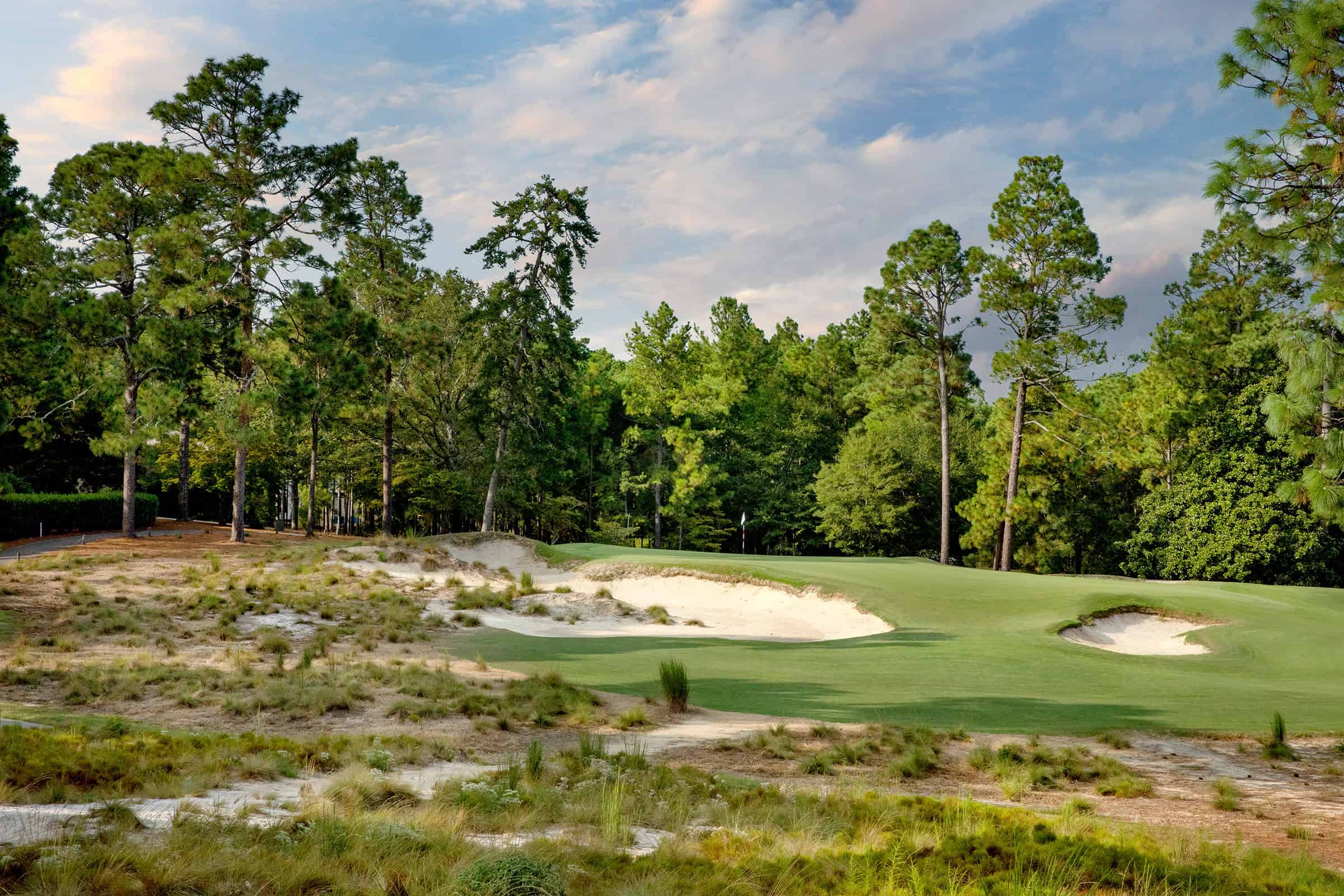
Donald Ross's masterwork unfolds across the sandy, rolling terrain of the North Carolina Sandhills, featuring crowned, convex greens that reject all but the most precisely struck approach shots. The 2010 restoration by Ben Crenshaw and Bill Coore stripped away decades of accumulated rough and cart paths, returning native wiregrass and sandy waste areas that Ross himself would recognize. More than 110 strategically placed bunkers frame fairways that demand thoughtful positioning over raw power.
History
The story of Pinehurst No. 2 begins not with golf but with a Boston soda fountain magnate's vision for a health retreat in the North Carolina Sandhills. In 1895, James Walker Tufts purchased nearly 6,000 acres of sandy, pine-covered land for roughly $1.25 per acre and hired the landscape architecture firm of Frederick Law Olmsted to plan a charming New England-style village. The resort that emerged, originally dubbed "Tuftstown" before taking the name Pinehurst, initially revolved around horseback riding, croquet, and the curative properties of the mild Southern climate. Golf was an afterthought -- until a young professional from Dornoch, Scotland, arrived in December 1900 and changed everything. Donald Ross had apprenticed under Old Tom Morris at St Andrews and served as the keeper of the green at Royal Dornoch before emigrating to the United States in 1899. When Tufts hired him as Pinehurst's head professional and course designer, Ross found in the sandy, gently rolling terrain of the Sandhills a landscape that reminded him of the linksland he had left behind. He designed and built four courses at Pinehurst over his lifetime, but none consumed his attention and affection like No. 2, which opened in 1907. Ross called it "the fairest test of championship golf I have ever designed" and continued tinkering with the layout for nearly four decades until his death in 1948, having spent the last 48 years of his life living at Pinehurst. Ross's genius at No. 2 is most evident in the greens. The putting surfaces were originally built low to the ground with subtle undulations, but decades of aggressive topdressing -- layering sand and clay to maintain smooth surfaces -- gradually elevated them into the famous "turtleback" shapes that define the course today. These crowned, convex greens resemble inverted bowls, with the highest point near the center and severe runoffs cascading to the edges. Approach shots that do not arrive with precisely the right trajectory and spin find the putting surface only temporarily before trickling into surrounding hollows, closely mown collection areas, and deep bunkers. Ross did not simply design putting surfaces; he sculpted entire green complexes of humps, hollows, and tightly mown contours that emulated the windblown dune formations of his native Scotland. As architect Bill Coore has observed, it was these surrounds -- not merely the greens themselves -- that created the extraordinary strategic interest Ross sought. The routing unfolds over gently undulating terrain through towering longleaf pines.2 is a par 70 that does not overwhelm with length but demands relentless precision. The fifth hole, a 588-yard par 5, doglegs left around a sandy waste area with a fairway that slopes from right to left, and its elevated green complex punishes anything less than a perfectly judged approach. The par-4 fourth, sweeping rightward through the pines, requires a tee shot threaded between sand on both sides. The finishing hole, a 451-yard par 4, has become synonymous with championship drama -- it was here that Payne Stewart drained an 18-foot par putt on the 72nd hole to win the 1999 U.S. Open by a single stroke over Phil Mickelson, an image of Stewart's fist-pumping celebration that endures as one of golf's most iconic moments. No. 2 holds a singular distinction in American championship golf: it is the only course to have hosted the U.S. Open, U.S. Women's Open, U.S. Amateur, and U.S. Women's Amateur. The 1999 U.S. Open was followed by Michael Campbell's victory in 2005, when the New Zealander held off Tiger Woods down the stretch. In 2014, Pinehurst made history by hosting the U.S. Open and U.S. Women's Open in consecutive weeks on the same course -- Martin Kaymer dominated the men's event with an eight-stroke victory, and Michelle Wie captured the women's title days later. The course also hosted the U.S. Amateur in 1962, 2008, and 2019, and the U.S. Women's Amateur in 1989. Then in 2024, Bryson DeChambeau claimed his second U.S. Open title at Pinehurst, holding off Rory McIlroy by a single stroke in a dramatic Sunday conclusion that echoed Stewart's heroics a quarter century earlier. Between championship eras, No. 2 underwent a transformative restoration that returned the course closer to Ross's original vision than it had been in decades. By the early 2000s, the course featured 40-plus acres of irrigated bermuda rough, narrowed fairways, and a manicured appearance far removed from the sandy, open landscape Ross had known. In 2010, the resort engaged architects Bill Coore and Ben Crenshaw to lead a year-long restoration that reopened in March 2011. Using aerial photographs from the nearby Tufts Archives as their guide, Coore and Crenshaw removed 35 acres of irrigated turf and replaced it with sandy, hardpan waste areas filled with pine needles and hand-planted native wiregrass. Fairways were widened by as much as 50 percent, restoring the strategic breadth Ross had intended. All maintained rough was eliminated, leaving just two heights of grass on the entire course: greens and everything else. The number of irrigation heads dropped from 1,200 to 450, and the club's water consumption fell by 73 percent. The result was a visually striking, environmentally sustainable landscape that looked and played far more like the course Ross had refined over his lifetime. The restoration also sharpened the strategic choices Ross built into his design. With wide fairways and no rough, players must choose their angle of approach carefully, as the turtleback greens reward specific entry points and reject others. Missing a green is not catastrophic -- there is virtually no chance of losing a ball on the entire course -- but the recovery shots from sandy waste areas and tightly mown surrounds demand creativity and touch. This emphasis on the short game and strategic decision-making, rather than brute length, is the hallmark of Ross's philosophy and the quality that has kept No. 2 relevant across more than a century of evolving equipment and athleticism. Pinehurst No. 2 is not merely a golf course but a living monument to its architect's vision and the sandy soil from which it was carved. Ross spent more time refining this layout than any other in his portfolio of nearly 400 designs, and the Coore-Crenshaw restoration ensured that his intentions endure for generations of championships to come. The USGA has affirmed its commitment to the course, with future U.S. Opens and Women's Opens already slated for Pinehurst, cementing No. 2's place at the center of American championship golf.