National Golf Links of America
16 Sebonac Inlet Rd, Southampton, NY 11968Designed by Charles Blair Macdonald · Est. 1911
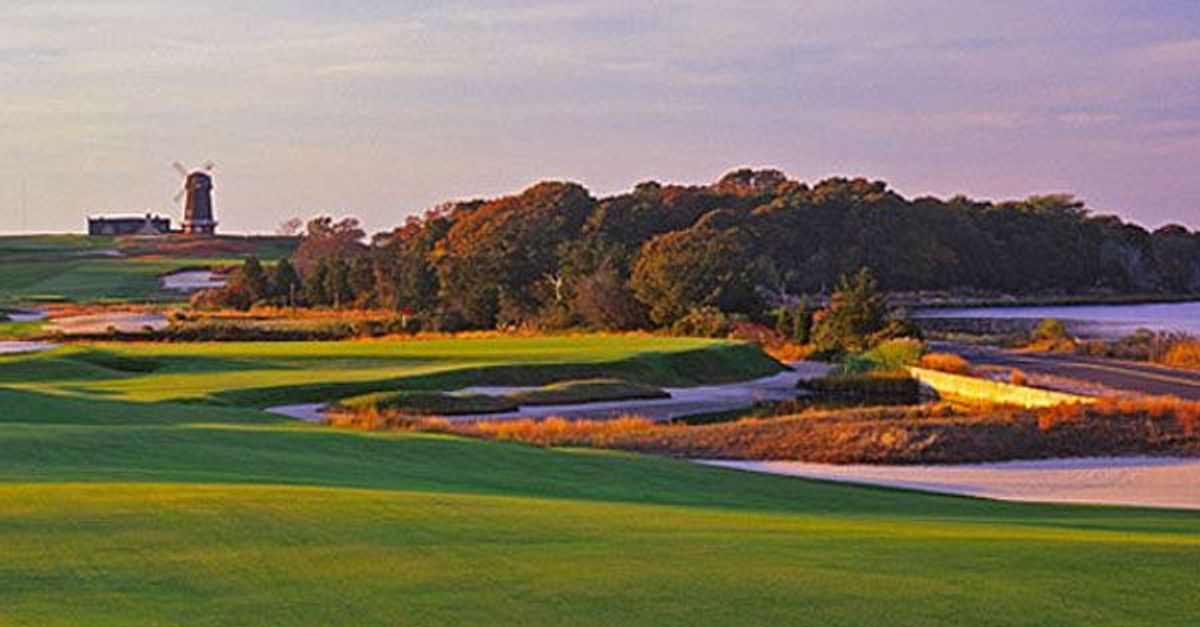
A masterwork of early American golf architecture on the eastern tip of Long Island, the National Golf Links of America was Charles Blair Macdonald's crowning achievement. Situated on Sebonac Neck between Shinnecock Hills and Peconic Bay, the course is a living museum of template hole design drawn from the great links of the British Isles.
History
The National Golf Links of America represents the physical manifestation of Charles Blair Macdonald's lifelong conviction that American golf course architecture should aspire to the standards set by the ancient links of the British Isles. Macdonald, born in 1855, was raised in Chicago but spent his formative years at the University of St Andrews in Scotland during the 1870s, where he learned the game on the Old Course under the tutelage of Old Tom Morris. That experience left an indelible mark. Macdonald returned to the United States determined to elevate the quality of American golf design, which he considered crude and unimaginative compared to what he had encountered in Scotland. Macdonald had already established himself as a central figure in American golf. He won the first U.S. Amateur Championship in 1895 and designed the Chicago Golf Club in Wheaton, Illinois, which became one of the five founding member clubs of the USGA in 1894. But these accomplishments only sharpened his dissatisfaction with the state of course design in America. He conceived of building a course that would incorporate the finest strategic principles he had observed abroad — a course that would serve, as he later wrote, as "an incentive to the elevation of the game in America." To prepare, Macdonald undertook a systematic study of the great holes of the British Isles. In 1902, 1904, and 1906, he traveled to England and Scotland, surveying and sketching the holes he admired most.
An article in Golf Illustrated had prompted a poll among leading British golfers about which holes were the most testing, and armed with their responses, Macdonald visited courses including North Berwick, Prestwick, St Andrews, Royal St George's, Sunningdale, Muirfield, Littlestone, Brancaster, and Leven. From these studies he assembled a collection of "ideal" holes — strategic concepts defined by their terrain, bunkering, and the types of shots they demanded. These became the templates that would define not only the National Golf Links but an entire school of American golf architecture. Macdonald searched Long Island's eastern end for a site that could approximate the character of seaside linksland, and in 1906 he found it: a stretch of rolling, sandy ground in Southampton, New York, overlooking Peconic Bay, situated adjacent to Shinnecock Hills Golf Club. In 1908, he organized a group of seventy founders, each contributing $1,000, and construction began. To execute the earthmoving and engineering, Macdonald enlisted Seth Raynor, a local Southampton surveyor who had never heard of golf. Raynor's engineering skills proved indispensable in translating Macdonald's conceptual drawings into physical reality, and the partnership between the two men became a standout consequential in golf architecture history. Raynor went on to become a celebrated architect in his own right, carrying the template philosophy to dozens of courses across the country before his own untimely death in 1926. The National Golf Links opened officially in 1911 as a par-72 course measuring approximately 6,873 yards. Its holes are named for the British originals that inspired them, and each embodies a distinct strategic concept.
The 2nd hole, "Sahara," is modeled after the 3rd at Royal St George's and demands a blind tee shot over a massive sand hill. The 3rd, "Alps," draws from the 17th at Prestwick, requiring an approach played blind over a large hill to a hidden green. The 4th, "Redan," replicates the celebrated 15th at North Berwick — a long par three to a green tilted diagonally from right to left with a deep bunker guarding the front. The 14th, "Cape," features a green originally set on a small peninsula jutting into a bay, demanding a tee shot whose line and length depend on how much of the hazard the golfer is willing to challenge. These template holes became the vocabulary of a design movement: Macdonald and Raynor, and later Raynor's associate Charles Banks, replicated and refined them at courses across the Eastern Seaboard. The National Golf Links was an immediate sensation upon its opening. Clubs around the country clamored for Macdonald's services, though he famously never charged a fee for his design work, considering course architecture a gentleman's pursuit rather than a profession. Macdonald continued to refine the National throughout his life, adjusting bunkering, green contours, and hole strategies as he deepened his understanding of the game and its architecture. He documented his philosophy and the story of the National in his 1928 book, "Scotland's Gift: Golf," a foundational text of golf literature that remains essential reading for students of course design. The club's most notable competitive moment came in 1922, when it hosted the inaugural Walker Cup, the biennial amateur team competition between the United States and Great Britain & Ireland.
The Americans won the first match 8 to 4. The Walker Cup returned to the National in 2013, reaffirming the course's standing as a championship venue nearly a century after its first major event. Over the decades, the National has been carefully maintained and periodically restored to preserve Macdonald's original vision. Gil Hanse conducted restoration work in the 2000s, focusing on recovering bunker shapes, green contours, and strategic angles that had softened over time. The intent has consistently been conservation rather than modernization — the membership has recognized that the course's value lies in its fidelity to Macdonald's original principles. The National Golf Links of America occupies a unique position in the history of the game. It is both a course and an argument — Macdonald's proof that the strategic ideals of British links golf could be transplanted to American soil without compromise. The template philosophy that Macdonald developed here influenced generations of architects, from Raynor and Banks to modern practitioners who continue to study and adapt his ideas. The course itself, set on its sandy Southampton hillside with views across Peconic Bay, remains a living monument to the proposition that great golf design begins with the careful study of what has come before.