Friar's Head
2850 Sound Ave, Baiting Hollow, NY 11933Designed by Bill Coore & Ben Crenshaw · Est. 2003
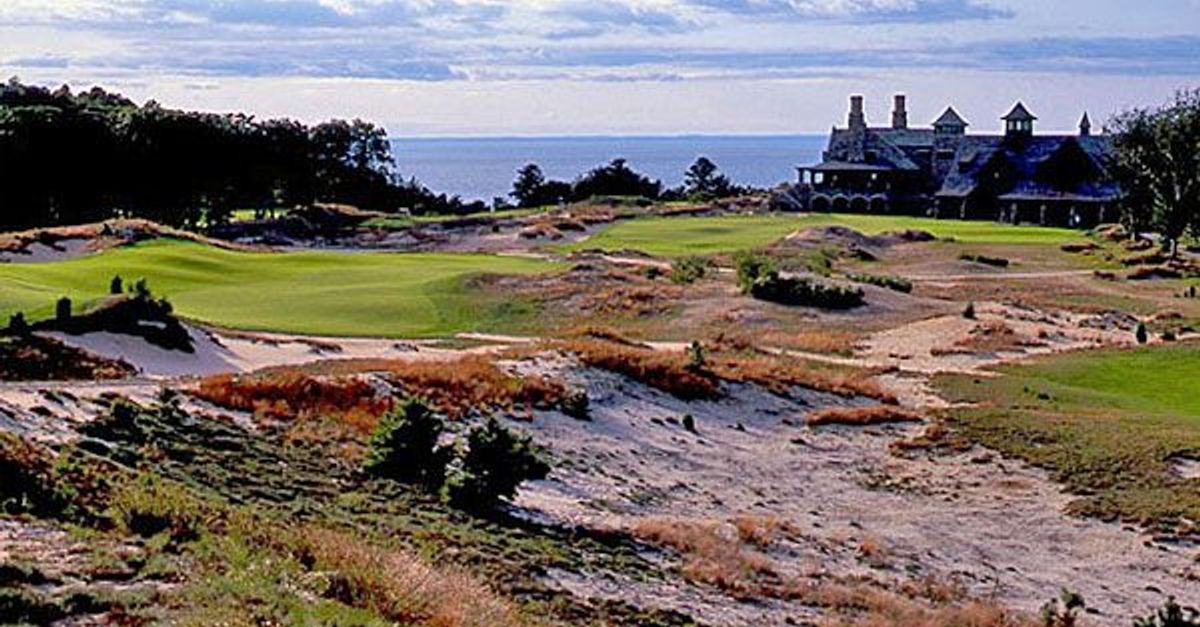
Nineteenth-century sailors navigating Long Island Sound saw a bald dune top ringed by vegetation and called it the Friar's Head. Coore and Crenshaw took that same wild, windswept land -- 200-foot bluffs above the Sound on one side, flat former potato fields on the other -- and routed 18 holes that move seamlessly between two completely different worlds. The coastal holes deliver some of the most dramatic views in American golf; the inland holes prove that great architecture needs nothing but strategy and turf.
History
Friar's Head owes its existence to a chance encounter between a remarkable piece of land and the right group of people to appreciate it. In the early spring of 1997, Ken Bakst -- a New York financier and accomplished amateur golfer who would win the USGA Mid-Amateur Championship later that year -- invited Bill Coore and Ben Crenshaw to tour a 350-acre block of land on the North Shore of Long Island, near the hamlet of Baiting Hollow in Riverhead, New York. The property was extraordinary in its contrasts. Its northern portion consisted of pristine sand dunes rising steeply 150 to 200 feet above Long Island Sound, with three-quarters of a mile of dramatic coastal bluffs. Its southern portion was flat former agricultural land -- potato fields that had been farmed for generations. Between these two extremes lay dense woods and scrubby underbrush that concealed the transitions between terrain types. The question was whether a single, coherent golf course could be built across such radically different ground. Coore and Crenshaw did not answer that question immediately. The architects delayed committing to Friar's Head for well over a year, making numerous site visits as they studied the land and searched for a routing that would unify the disparate terrain into something greater than the sum of its parts. They were philosophically opposed to heavy earthmoving and strongly believed that the site deserved more than what they called a "Jekyll and Hyde course" -- one that simply alternated between spectacular dunes holes and ordinary flat holes.
The puzzle was finding a circulation pattern that moved between the sand hills and the softer ground with genuine continuity, so that the transitions felt natural rather than jarring. Only after they were confident they had solved this fundamental problem did they agree to proceed. Construction began around 2000 and lasted approximately three years, with meticulous attention to detail at every stage. The course opened in 2003 as a par 71 stretching just over 6,700 yards from the back tees. The routing that Coore and Crenshaw devised is widely regarded as one of their finest achievements -- and given a portfolio that includes Sand Hills, Streamsong Red, and Bandon Trails, that is saying a great deal. The course begins among the dunes, with the opening hole establishing the dramatic scale of the coastal portion of the property. Holes two through seven then move south onto the former potato farmland, where the architects created interest through careful shaping of bunkers, green complexes, and subtle ground contours rather than relying on the natural drama of the terrain. The design team managed to devise a circulation pattern that ebbs and flows effortlessly between the sand and softer ground, with minimal earthworks required to build the holes and, critically, short walks between greens and tees. The individual holes at Friar's Head display the variety and imagination that define Coore and Crenshaw's best work. The fourth is a demanding par three that plays to an elevated green guarded by sand on the left and closely-mown surrounds that send near-misses into awkward thirty- or forty-yard pitch shots to a putting surface that resists holding approach shots.
The thirteenth, a 495-yard par five, is superlative in every respect -- both fun and challenging for every level of player, with central hazards in the sixty-yard-wide fairway creating strategic choices while the last fifty yards to the green are left open for ground-game approaches. The tenth hole, which begins the inward run, is a unique par three set among the sand dunes that can measure anywhere from 110 to 235 yards depending on the tee selection, its enormous green offering wildly different challenges based on pin position. The fourteenth is a brilliant par five that slowly rises through forested dunes toward a steeply pitched green nestled beneath converging ridges. The sixteenth is a deceptive par four that dares players to challenge the left side of the fairway while a rising ridge and distant dune obscure the true dimensions of the landing area. The finishing stretch -- the fifteenth through eighteenth -- winds around a massive expanse of land that the architects left entirely untouched, a testament to their restraint. The seventeenth is a sinister short par three with a green approximately one-fifth the size of the tenth's enormous putting surface, and the eighteenth is a strong par four that bends around the shoulder of a giant dune hill. The design philosophy at Friar's Head is rooted in the ground game. Coore and Crenshaw are the foremost practitioners of minimalist golf architecture, and their work here reflects their conviction that the best golf holes present options rather than demands. Approaches can be bounced into greens, chips can be played along the ground, and the firm, fast playing surfaces reward imagination over brute force. The course does not impose a single method of play but instead invites golfers to read the terrain and choose their own paths.
This philosophy connects Friar's Head to the oldest traditions of links golf, even though the course itself is not a true links in the technical sense. The club that Bakst founded is intentionally small and private, with membership capped to preserve the quality of the experience and the sense of solitude that the property provides. There is no real estate component, no massive clubhouse complex -- just the golf course, a modest but well-appointed facility, and the land itself. The club's identity is defined entirely by the quality of the architecture and the beauty of the setting: the panoramic views of Long Island Sound from the bluffs, the quietude of the former farmland holes, the wind off the water, and the ever-changing light on the dunes. Friar's Head has received consistent recognition since its opening. It regularly appears among the top twenty courses in the United States in rankings by Golf Digest and Golf Magazine, and it is frequently cited by architects and critics as one of Coore and Crenshaw's two or three greatest designs. The course has not hosted -- and likely never will host -- a major professional championship, as that was never its purpose. Friar's Head was built for the pure enjoyment of golf, for the pleasure of walking a beautifully routed course across varied and dramatic terrain, and for the challenge of solving the architectural puzzles that Coore and Crenshaw embedded in every hole. In that mission, it succeeds completely. The course that took more than a year to conceive and three years to build has become a standout admired golf course of the twenty-first century, a place where the land, the architecture, and the game exist in rare and perfect harmony.