Erin Hills
7169 County Road O, Hartford, WI 53027Designed by Michael Hurdzan · Dana Fry · Ron Whitten · Est. 2006
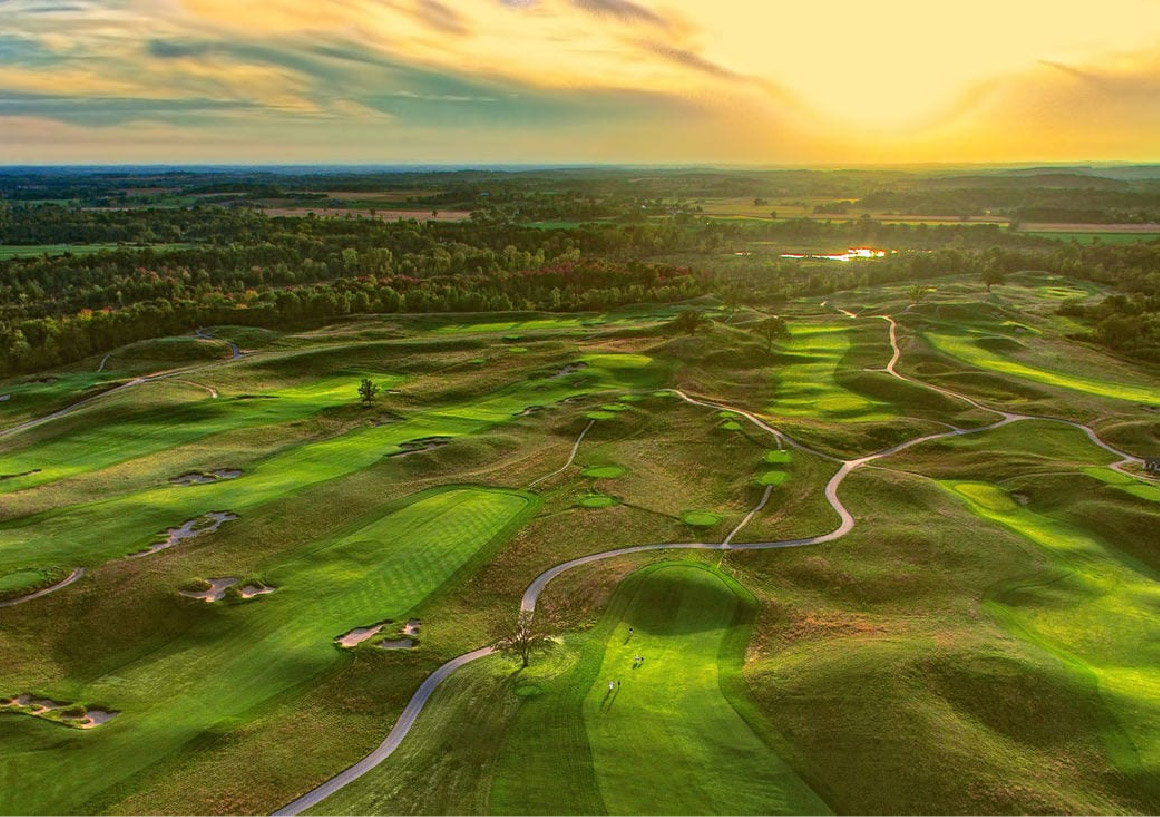
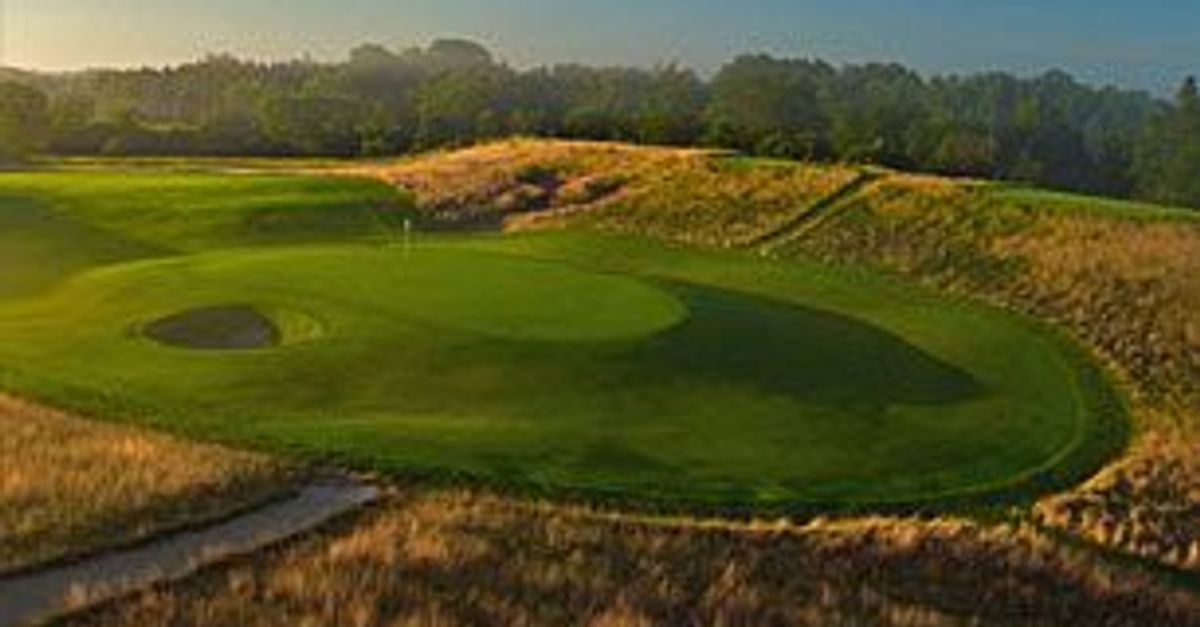
Erin Hills stretches across 652 acres of glacial terrain in Washington County, Wisconsin, featuring dramatic elevation changes, fescue-covered hillsides, and vast wetland corridors that give the course a wild, untamed character. The routing traverses kettle moraines and drumlins left by the last Ice Age, with holes that rise to ridgeline vistas and descend into sheltered valleys. At nearly 7,800 yards from the back tees, it is one of the longest courses in American championship golf.
History
Erin Hills traces its origins to 1999, when Bob Lang, a Chicago-area real estate developer with no prior background in golf, purchased 640 acres of former pastureland in the Town of Erin, Wisconsin. Lang had been captivated by the extraordinary terrain of the Kettle Moraine, a geological formation shaped roughly 18,000 years ago when two massive glaciers collided at right angles during the last Ice Age. As the ice receded, it left behind a landscape of rolling ridges, deep kettles, and sweeping valleys unlike anything else in the Midwest. Lang recognized that this dramatic ground, with its natural movement and sandy glacial till, could support a truly exceptional golf course. Lang hired the architectural team of Dr. Michael Hurdzan and Dana Fry, choosing them over bigger names including Jack Nicklaus. Ron Whitten, the longtime architecture editor of Golf Digest, joined the team as a design associate in 2000 to help refine the routing. Construction began in earnest in 2003. The design philosophy was resolutely minimalist: rather than imposing manufactured features onto the site, the architects allowed the ancient glacial topography to dictate the placement and shape of every hole. Hurdzan later described the process as discovering holes that "seemed to emerge from the property" rather than being built upon it. The course officially opened in August 2006 as an 18-hole, par-72 layout spanning 652 acres -- a remarkably generous canvas that gave each hole ample room to breathe within the undulating terrain.
The architects incorporated approximately 138 bunkers with naturalistic, irregular edges that blended seamlessly into the native grasses. Bentgrass greens, averaging 6,650 square feet with sizes ranging from 3,800 to 10,900 square feet, provided a rich variety of putting challenges. Wide fairways averaging 50 yards -- ranging from 40 to 70 yards across -- rewarded strategic thinking over brute force while still demanding precise shot-making to reach the best angles into the green complexes.
Financial pressures from the Great Recession forced Lang, who had invested nearly $25 million over a decade, to sell the property in October 2009. Andrew Ziegler, a Milwaukee-based venture capitalist and co-founder of Artisan Partners Asset Management, acquired Erin Hills for approximately $10.5 million. Under Ziegler's stewardship, a comprehensive renovation was completed by July 2010 that reshaped greens, enhanced drainage systems, and improved infrastructure to meet USGA championship standards. Critically, Ziegler implemented the walking-only policy that now defines the Erin Hills experience. With no cart paths anywhere on the property, golfers traverse the kettle moraine landscape entirely on foot, accompanied by one of up to 150 professional caddies available to provide strategic guidance and read the subtle green contours.
Erin Hills wasted no time establishing itself as a championship venue. In 2008, it hosted the U.S. Women's Amateur Public Links -- the first USGA championship held in Wisconsin since 1952 -- won by Tiffany Joh. The 2011 U.S. Amateur followed, with Kelly Kraft claiming the title 2-up in the final match. These events served as proving grounds for what would become the course's defining moment: the 2017 U.S. Open. Brooks Koepka delivered a dominant performance that June, posting a 16-under-par total of 272 to win his first major championship by four strokes over Brian Harman and Hideki Matsuyama. His winning score tied the lowest in U.S. Open history, matching Rory McIlroy's record from Congressional in 2011. The course was set up at 7,741 yards for the championship, and its wide fairways combined with thick fescue rough rewarded aggressive driving while severely punishing wayward shots. Following the 2017 championship, Erin Hills converted its fairways from fine fescue to creeping bentgrass in 2020, a significant agronomic shift aimed at improving year-round playability and conditioning. The change maintained the firm, fast character of the playing surfaces while providing more consistent turf quality across Wisconsin's variable growing seasons. The course continued to attract major championships. The 2022 U.S. Mid-Amateur saw Matthew McClean of Ireland earn a 3-and-2 victory in the final. In 2025, Erin Hills hosted the U.S. Women's Open for the first time, with Sweden's Maja Stark capturing the title at 7-under-par 281, holding off Nelly Korda by two strokes. The USGA's commitment to the venue extends deep into the future: Erin Hills is scheduled to host the U.S. Amateur Four-Ball in 2027, the U.S. Women's Amateur Four-Ball in 2030, the U.S. Women's Amateur in 2033, the U.S. Amateur in 2035, and the U.S. Junior Amateur in 2039. By that final event, Erin Hills will have hosted nine different USGA championships, tying the record for the most diverse slate of national events at a single venue.
Among the course's most memorable holes is the par-5 18th, which stretches from 539 yards from the forward tees to a formidable 675 yards from the championship markers, playing directly toward the spire of Holy Hill in the distance. The par-3 9th drops downhill to a push-up green, while the 15th features an elevated perched green that demands precise distance control.From the Black tees, the course carries a rating of 77.9 and a slope of 145. Erin Hills has earned consistent recognition in national rankings, sitting at 49th on Golf Digest's 2025-26 America's 100 Greatest Golf Courses list and 10th among America's Greatest Public Courses. As a public-access facility with no membership requirement, it stands as a rare example of a course that welcomes all golfers while simultaneously hosting the game's most demanding championships. The vision that Bob Lang first imagined on that glacial terrain, refined by three thoughtful architects and elevated by Andrew Ziegler's commitment to championship standards, has produced a significant American golf course of the 21st century.