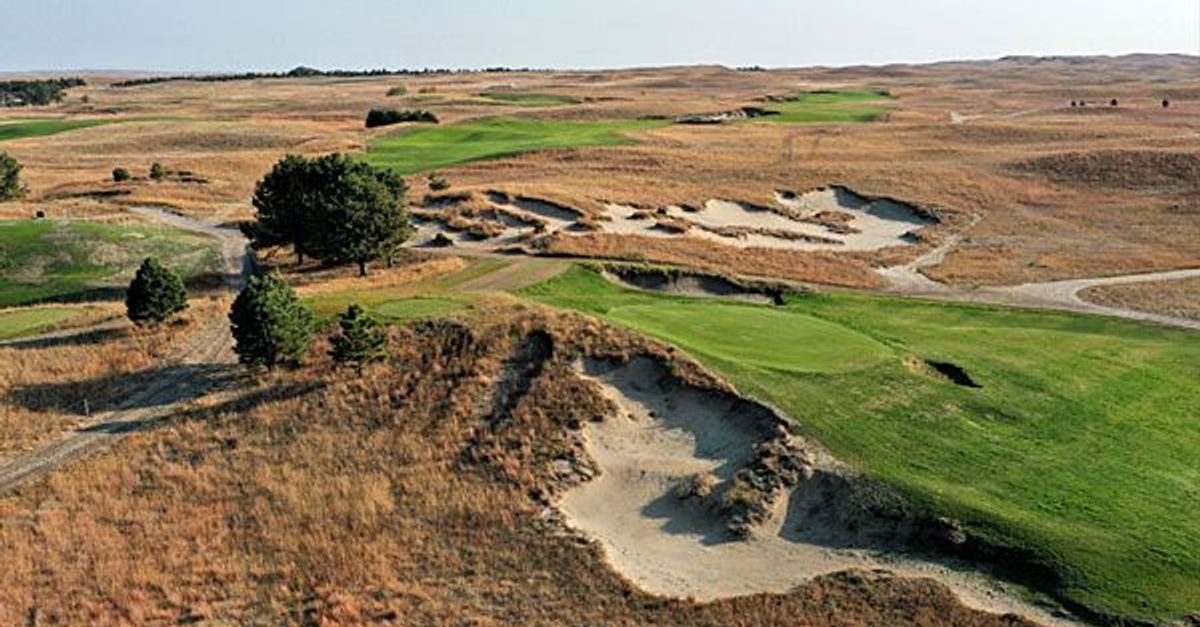

a remarkable Gil Hanse design tracing the dramatic caprock cliffs of the Snake River Canyon in the Nebraska Sandhills. Named Golf Digest's Best New Course of 2021, eight holes frolic along and over the pine-forest rim of the canyon, dropping several hundred feet to the riverbed below.
History
The story of CapRock Ranch begins in 2001, when Gil Hanse, then a young architect little known outside the most dedicated golf architecture circles, first visited a remote site along the Snake River Canyon just south of Valentine in the Sandhills of northwest Nebraska. Hanse developed a routing for the property, recognizing immediately that the landscape offered something found nowhere else in the golf world: the point where the gentle, grass-covered dunes of the Nebraska Sandhills fall away from dramatic caprock cliffs to the Snake River bed, a geological formation carved over 6,000 years. But for various reasons, the project stalled, and the routing sat dormant for nearly two decades. In 2018, an investment group led by John Schuele purchased the land and brought Hanse and his design partner Jim Wagner back to complete the unfinished business. Construction commenced in 2019, and the course opened in 2021. By then, Hanse had become a celebrated architect in the game, his portfolio including the Olympic Course at Rio de Janeiro's Gil Hanse Golf Course for the 2016 Olympics and restoration work at iconic venues. He returned to the Nebraska Sandhills with far more experience but the same reverence for the site that had captivated him two decades earlier. Hanse has spoken eloquently about the setting. "I've traveled all over the world," he has said, "and if you told me 20 years ago that a beautiful views I'd ever see was in Nebraska, I'd have laughed at you. But it's as beautiful as anything I've ever seen." The property sits roughly a mile north of the Prairie Club and within the broader constellation of Sandhills courses that includes Sand Hills Golf Club, where Hanse served as an associate under Bill Coore and Ben Crenshaw in the mid-1990s. Hanse has called Sand Hills "the best course of a generation," and CapRock Ranch represents his own deeply personal engagement with the same region. The course is two golf landscapes rolled into one.
Ten holes play across links-style terrain, bumbling over prairie chop hills covered in native grass, with the sandy soil providing firm, fast playing conditions. The remaining eight holes are routed along and over the pine-forested rim of the Snake River Canyon, where the land drops more than 200 feet to the riverbed below. The interplay between these two landscapes, the peaceful rolling prairie and the dramatic canyon edge, gives CapRock Ranch a rhythm unlike any other course. Hanse's routing takes deliberate inspiration from Cypress Point, moving players in and out of the property's most dramatic terrain rather than camping on the canyon edge for the entire round. The par-three third hole crosses the canyon edge and begins a four-hole stretch of dramatic canyon-hugging golf. Four of the course's five par threes play along the canyon, and the collection of one-shotters stands as the clear highlight of the design. The sixteenth, at 145 yards, is a short hole that plays along the canyon wall, demanding precise distance control with an abyss awaiting any ball that drifts right. The fifteenth, a 470-yard par four, features what has been described as an infinity-edge green perched on the canyon rim, where the putting surface appears to drop off into the void beyond. The seventeenth hole, a drivable par four of 358 yards that tumbles downhill along the Snake River Canyon, is widely regarded as the best hole on the course. The tee shot requires players to choose between a conservative play to the widest part of the fairway and an aggressive line that flirts with the canyon edge but leaves a chip or short pitch to the green. It is a hole that rewards boldness without punishing caution, the hallmark of thoughtful risk-reward design.
The eighteenth is a dramatic finishing hole and a standout visually striking par threes in American golf. Playing 213 yards uphill over a substantial canyon chasm with a fronting bunker, it demands a confident, committed swing to carry the gorge and find the putting surface. Ending the round on a par three is an unusual routing decision, but the hole's drama and difficulty make it a fitting conclusion. The course also ends each nine with a par three, another distinctive sequencing choice that underscores Hanse and Wagner's willingness to let the land dictate the routing rather than adhering to conventional formulas. The second hole, a 578-yard par five, is an S-shaped double dogleg that showcases the rolling prairie terrain. The seventh, a 470-yard par four, features a blind tee shot that adds an element of mystery. Throughout the course, the greens feature more sloping than undulation, with surfaces that reward players who read the terrain correctly and punish those who misjudge the subtle breaks. One distinctive element of CapRock Ranch's construction was Jim Wagner's insistence that the Hanse Golf Design team, nicknamed the Cavemen, complete all hand-finish shaping work themselves rather than delegating to third-party contractors. This is typically the final phase of course construction, where the fine details of bunker faces, green surrounds, and fairway contours are refined. Wagner understood the potential for beauty at CapRock Ranch and wanted every surface to reflect the team's direct artistic vision. The result is a level of craftsmanship in the shaping that is visible throughout the course.
CapRock Ranch plays to a par of 71, with five sets of tees ranging from 4,876 yards to 6,998 yards. The course accommodates approximately 180 members and operates as a private club with on-site cottages perched on the canyon rim alongside the clubhouse. The routing intentionally creates multiple crossover points near the clubhouse, allowing members to devise shorter loops when time or weather dictates. The recognition came swiftly. Golf Digest named CapRock Ranch the Best New Course in America for 2021, and it became the only new course built in the modern era to break into the 2022-23 U.S. Top 100 rankings. For a project that spent nearly 20 years in limbo, the acclaim validated what Hanse sensed on his first visit in 2001: that the confluence of Sandhills prairie and Snake River Canyon represented one of the great undiscovered golf landscapes on the continent. CapRock Ranch has taken its place alongside Sand Hills, the Prairie Club, and Dismal River as a pillar of Nebraska's remarkable golf corridor, a region that continues to redefine what American golf architecture can achieve when architects are given extraordinary land and the freedom to honor it.