California Golf Club of San Francisco
844 W Orange Ave, South San Francisco, CA 94080Designed by A. Vernon Macan · Est. 1926
Redesigned by Alister MacKenzie (1929)
Redesigned by Kyle Phillips (2007)
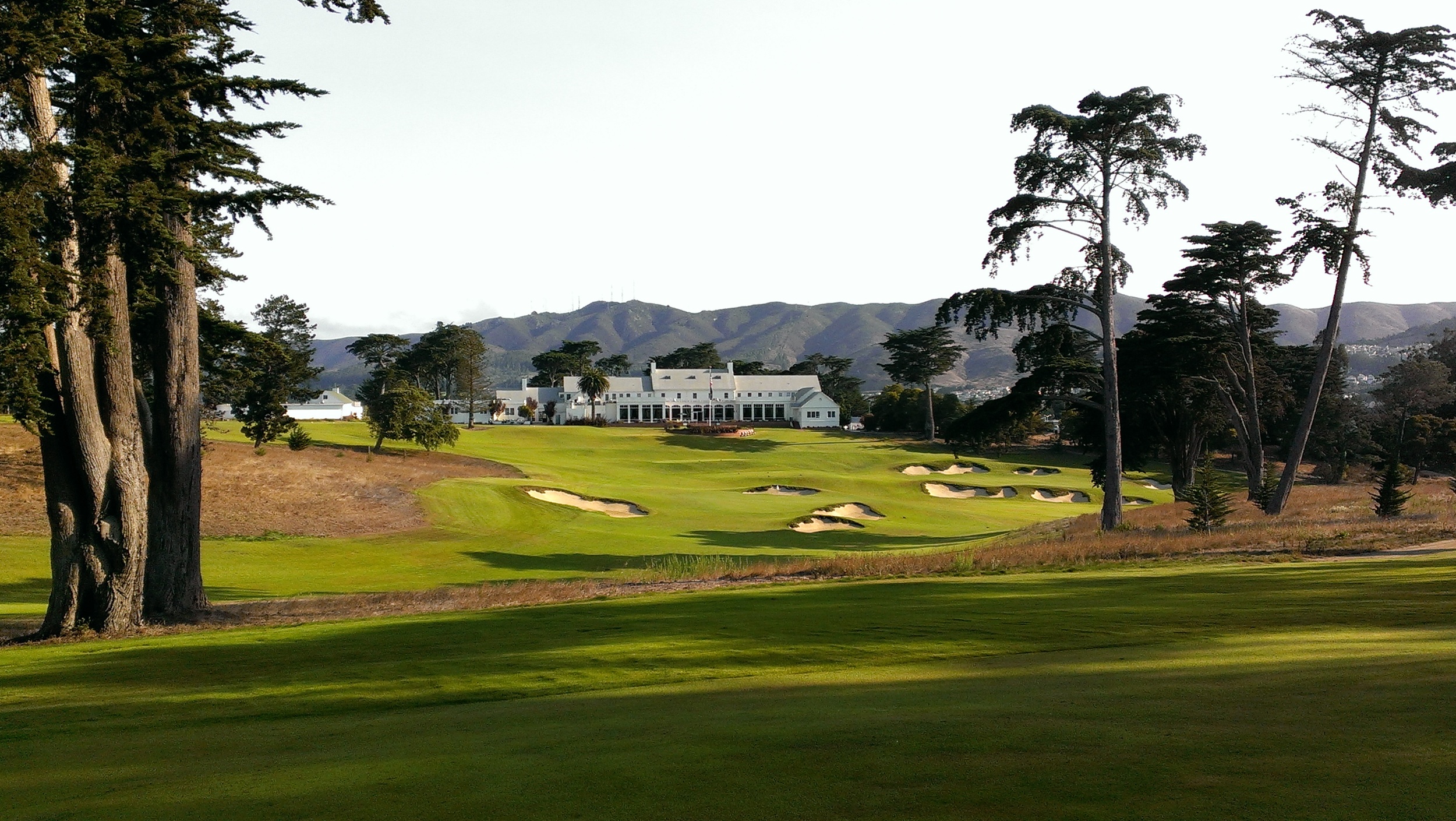


Three architectural eras live in one course: Vernon Macan routed the original through coastal Peninsula hills in 1926, Alister MacKenzie redesigned the bunkering and rebuilt greens two years later, and Kyle Phillips restored the whole composition in 2008. The result at Cal Club is a layered Golden Age masterpiece where ground-game golf thrives beneath Monterey cypress on the hills south of San Francisco.
History
The California Golf Club of San Francisco -- known affectionately as "Cal Club" -- traces its origins to 1918, when a group of golfers established a club on leased land in the Ingleside neighborhood, southwest of San Francisco. The property belonged to the Spring Valley Water Company, and the arrangement worked well enough for several years. But the inability to secure a long-term lease forced the club to consider its future, and in 1924, the members made a decisive move: they purchased approximately 425 acres down the Peninsula in what is now South San Francisco. The land had been part of the original Baden Farm, and its rolling hills, mature timber, and sweeping views of the Bay created an ideal setting for a course of real character. To design their new course, the members enlisted Willie Locke and A. Vernon Macan. Macan is generally credited as the architect of record, though Locke's contribution to the routing was significant and deserves recognition. Macan himself was a fascinating figure in the history of golf architecture. Born in Ireland, he immigrated to Canada in the early twentieth century, trained as a lawyer, and became an accomplished competitive golfer. He returned to Europe under the Canadian flag to fight in World War I and lost the lower portion of his left leg, yet he returned to competitive golf and eventually turned his attention to course design, producing notable layouts across the Pacific Northwest and northern California. The course at Cal Club opened for play on May 26, 1926. Not long after the course opened, another celebrated architect left his mark on the property.
Alister MacKenzie, the Yorkshire-born doctor turned golf course designer who was then at the height of his career, redesigned the bunkering and at least two of the greens at Cal Club. This work was completed just prior to MacKenzie's involvement at nearby Cypress Point Club, placing Cal Club in distinguished architectural company. MacKenzie's influence gave the bunkering a more strategic, naturalistic quality that complemented Macan's routing. For decades, Cal Club operated as a well-regarded but somewhat under-the-radar Bay Area club. The course occupied rolling terrain that caught afternoon fog drifting in from the Pacific, creating growing conditions that differed markedly from the rest of coastal California. Where most courses in the region contend with poa annua and kikuyu grass, Cal Club's cooler, foggier microclimate would eventually prove ideal for finer turf grasses -- a characteristic that would become central to the club's identity after its transformation in the twenty-first century. Over the years, changes accumulated. Trees were planted, ponds were added, the driving range was positioned near the clubhouse, and the original character of the course was gradually diluted. By the early 2000s, the layout bore only a partial resemblance to what Macan and MacKenzie had shaped. The turning point came unexpectedly. A nematode infestation in the greens necessitated a conversion to bentgrass, and what began as a focused greens renovation evolved into something far more ambitious. In April 2007, the club engaged architect Kyle Phillips to lead a comprehensive restoration.
Phillips, best known for his work at Kingsbarns in Scotland, brought a deep appreciation for Golden Age design principles and a willingness to make bold decisions. Working closely with course superintendent Thomas Bastis, Phillips developed a radical plan that went far beyond turf replacement. He proposed re-routing portions of the front nine, building five new holes, relocating the practice range away from the clubhouse, filling in two ponds that were aesthetically and strategically incongruous, adding approximately 450 yards to the overall length, and restoring fairway widths and bunkering to something approaching their original dimensions. Construction began in August 2007, and the project was completed eighteen months later in July 2008, at a cost of approximately thirteen million dollars. The results were transformative. Phillips restored the ground-game quality that Macan and MacKenzie had originally intended, converting the fairways to fine fescue and colonial bentgrass and the greens to creeping bentgrass. Unlike the spongy conditions found at many coastal California courses, Cal Club now offered firm-and-fast playing surfaces where the ground game flourished -- a ball could be bumped and run onto greens, fairways played with the kind of bouncy interaction more commonly associated with British links. The Bay Area's challenging growing conditions -- daytime highs often in the fifties with afternoon fog rolling in -- made establishing the fescue difficult in the first year after renovation. But the superintendent and his team persevered, and the turf matured into exactly what Phillips had envisioned: firm, brown, and fast, a dramatic contrast to the lush green conditions that characterize most American private clubs. The renovation catapulted Cal Club into the national conversation. In 2009, the course debuted on Golfweek's Best Classic Courses list at number 60, and it has continued to climb in rankings since. The combination of MacKenzie-influenced bunkering, Phillips's modern routing, and the unique playing conditions created by the microclimate give the course a personality unlike anything else in California.
Visually, Cal Club rewards attention. Long-range views of the Bay Area appear and disappear through gaps in the fog. The bunkering, restored to a style reminiscent of MacKenzie's work, is both beautiful and strategically demanding. The rolling terrain provides natural movement and variety, with holes flowing up, down, and across the contours of the former farmland. The club's tournament history, while modest compared to some of its neighbors, includes hosting the 1970 U.S. Senior Men's Amateur Championship, won by former Walker Cup player Gene Andrews. That event remains a proud chapter in the club's history. Today, the California Golf Club of San Francisco stands as a testament to what thoughtful restoration can achieve. The work of Kyle Phillips did not erase the contributions of Macan and MacKenzie but rather honored and amplified them, stripping away decades of accumulated changes to reveal the bones of a Golden Age course and then adding modern touches that enhance rather than obscure the original vision. For golfers who appreciate firm turf, strategic bunkering, and a setting where fog and wind are as much a part of the challenge as any hazard on the scorecard, Cal Club offers an experience that is distinctly its own -- a Bay Area treasure that has earned its place among the finest courses in the state and the nation.